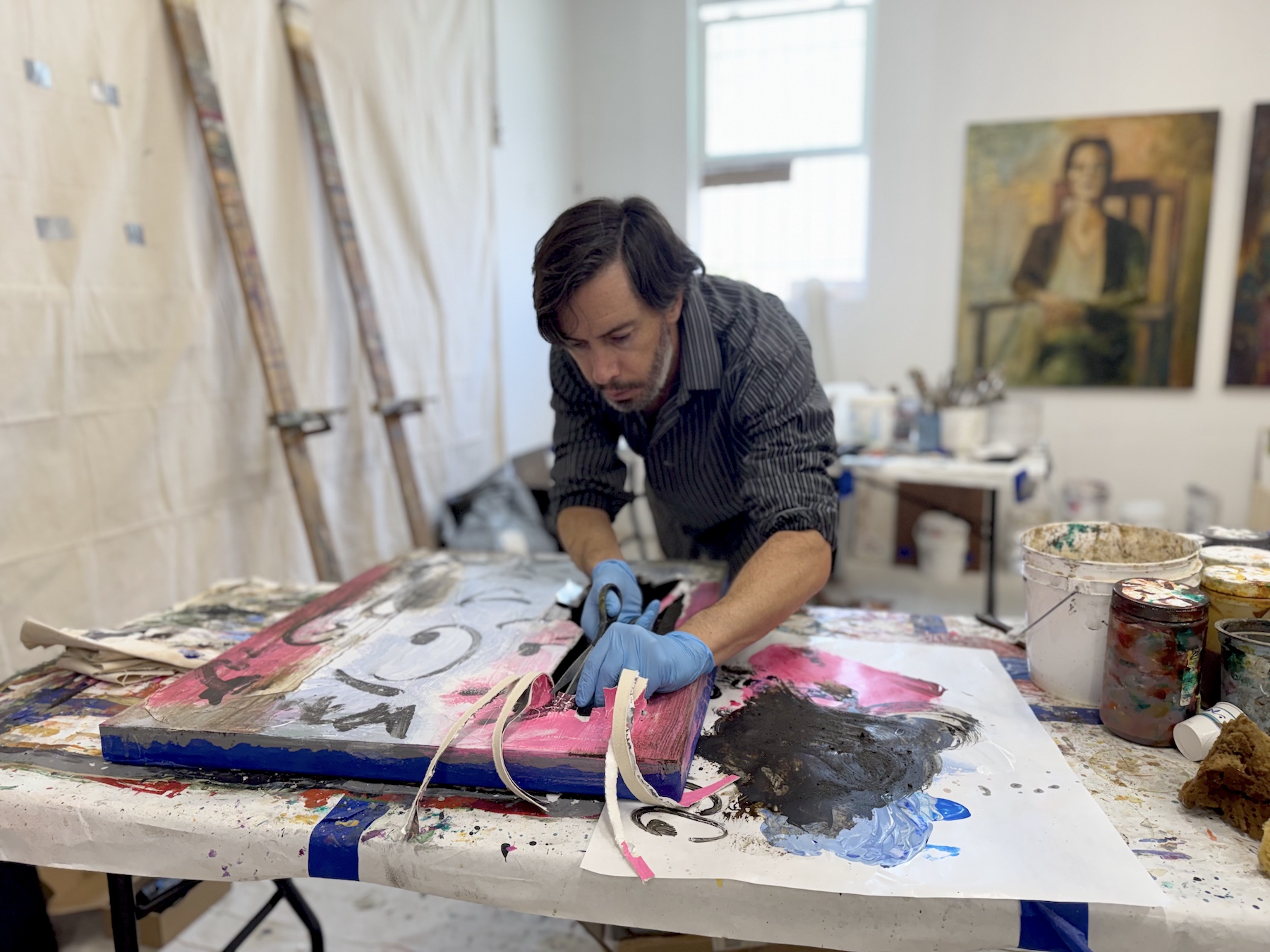
Can you tell us a bit about yourself and your artistic journey? What first drew you to making art, and how has your practice evolved over time?
Ever since I can remember, I was drawn to drawing and making images. As I moved through university and graduate school (where I studied television, video, and film production) I started to recognize how deeply art connects to everything: psychology, culture, science, beliefs, and the ways we construct meaning. That realization shifted it from something purely aesthetic into an intellectual pursuit as well.
My early work centered on painting, often moving between abstraction and representation. The human figure became a way to hold psychological states within a shifting environment. Over time I became interested in incorporating other materials into the painting process.
That shift gradually moved the practice into a space between painting and sculpture. Figures fragment, mineral structures emerge, clay naturally cracks across a surface, and light activates cavities that feel as though they’re still forming. I’m interested in the tension between what feels fragile or temporary, and materials that imply permanence or geological duration. My recent works often sit somewhere between organism, fossil, and artifact.
Your body of work, including the sculptures and paintings on view in The Holdings, is a response to the growing fragmentation of human connection in the digital age and also an exploration of the lines between the living and the dead. How are these concepts manifested in the pieces we see in this exhibition?
The works in this exhibition begin with the recognition that the human body is made of the same atoms and molecules found in stones, rivers, trees, mud, oil, paint, and clay. Modern civilization often forgets that everything is connected. By placing fragments of the human figure in direct relation with geological forms and other materials, the works reassert this concept, simply unfolding across different time scales.
At the same time, the pieces respond to the growing fragmentation of human connection in the digital age. Many of the figures appear isolated or suspended within their environments, yet they function less as objects than as presences. They carry echoes of solitude, longing, and the quiet hope of communion.
This tension also blurs the boundary between the living and the dead. Mineral matter appears inert but forms through slow generative processes, while the human body is temporary and constantly transforming. The works stage a space where those distinctions begin to dissolve, suggesting a world in which everything remains part of the same ongoing material cycle.
Is there a particular piece or pieces in the show that feel especially meaningful to you right now, whether from a personal or philosophical standpoint?
I don’t think of one piece as standing above the others. Each work represents the same condition for me, where creativity flows at full effort, and the creation unfolds without expectations beyond an underlying need to connect.
That connection isn’t only between individuals. It’s also between the physical and the intangible, the seen and the felt, the rational and the inexplicable. Each piece holds those dimensions together in the same space.
You’ve described creating your art as “a solitary act, born from deep introspection but also driven by an undeniable desire to connect.” How do you navigate the duality between the solitary nature of the creative process and the desire to interact and share your work with an audience?
The work begins in solitude. The studio is a space where I’m listening closely to things that are often difficult to articulate, such as feelings, intuitions, and contemplations that cannot be explained with language. It’s a slow process of trying to give form to something that is sensed more than understood.
But that solitude is never the end point. The reason to make the work at all is the possibility that someone else might encounter it and recognize something of their own experience in it. Each of us carries emotions and reflections that shimmer with significance but resist explanation. They can be enigmas that remain somewhere in the heart, neither fully revealed nor erased. The artworks try to hold those conditions in material form.
So the solitary act of making is really the first half of a conversation. When the work enters the world and someone stands before it, their own thoughts and feelings complete the circuit. In that moment the work becomes a place where the physical and the intangible, the seen and the felt, can meet. It is where art expands beyond the limits of language and creates an unspoken form of connection.
What would you invite or challenge visitors to reflect on as they spend time viewing your work in the gallery?
I would simply invite visitors to spend a little more time with each work than they might normally expect to. In our digital world, we’ve grown so very accustomed to moving quickly from one image to the next, absorbing things in brief moments rather than sustained encounters.The works in this exhibition ask for a slightly different kind of attention.
This invitation to pause and reconnect with a quieter mode of perception isn’t a demand that viewers arrive at a definitive explanation. Rather, by allowing a moment of reflection, something felt, sensed, or remembered might briefly surface in the presence of the work.
Many of the works’ details reveal themselves more slowly. They aren’t meant to be resolved immediately, but experienced over time.
Is there a detail or aspect of the work that viewers might initially overlook but that holds particular meaning for you?
Often it’s something subtle within the interior of the work that can be easily overlooked at first. For example, some pieces contain cavities or mineral formations that only become visible after spending time with them. They can initially appear purely structural, but for me they suggest an inner condition, something present but not immediately revealed.
A similar dynamic occurs with some of the butterflies that appear in a few works. It’s an image that people can quickly attach a meaning to, or read as decoration. But that isn’t really the intention. I’m more interested in the butterfly as a presence within the larger structure of the piece, something delicate and fleeting appearing alongside permanence, or alongside forms that suggest deep time and pressure.
These kinds of details function almost like processes unfolding beneath the surface. They point to the tension between what is visible and what remains hidden, between what can be explained and what can only be sensed. In that way, the elements that might initially seem secondary actually carry a deeper role.
Is there anything else you would like to share with readers or visitors coming to see this exhibition?
The spoken word is powerful, but it also has limits. The psychiatrist, Carl G. Jung, observed that consciousness naturally resists what is unconscious or unknown, and that modern societies often erect psychological barriers to protect themselves from encountering something unfamiliar. Jung also noted that in earlier or “primitive” worldviews, animals, plants, and stones were often understood to possess a kind of presence or power, often depicted in ancient art. Rather than dismissing that perspective, the exhibition invites viewers to reconsider it, perhaps not literally, but imaginatively, where boundaries are less fixed and assumptions less certain.
About Lucas Novak
Lucas Novak was born in Southern California and currently works in his Los Angeles studio. His work has been exhibited nationally and internationally at the Orange County Museum of Art, CA; Jangsu Art Museum, South Korea; Los Angeles Art Show, CA; Schema Art Museum, South Korea; Los Angeles Municipal Art Gallery, CA; Santa Clarita City Hall, CA; bG Gallery, Santa Monica, CA; Gestalt Projects, Santa Monica, CA; Art Depot Gallery, Fontana, CA; El Dorado Nature Museum, Long Beach, CA; San Diego Art Institute, CA, among others. His works are included in the collections of California State Polytechnic University, Pomona, CA; Clinton & Clinton Law Corporation, Long Beach, CA; Harris County District Attorneys Office, TX; The Workplace California, Santa Ana, CA; and numerous private collections.
Find out more about Lucas Novak: @LucasNovakArt lucasnovak.com.
Input your search keywords and press Enter.